4OTC – Building ultra-low-latency FX & digital asset connectivity services with Aeron Transport using IPC and SBE

At a recent Aeron MeetUp in London, Mark Price, Co-Founder at 4OTC shared how the firm uses Aeron and SBE not just for raw performance, but as architectural “building blocks” for scalable, ultra-low-latency connectivity services in digital asset and FX markets. The talk focused on modular monolith patterns, sharding, IPC extensibility, and replay-based debugging, all running over Aeron Transport using IPC. Watch the full recording of this session here.

Who is 4OTC and what do they do?

4OTC provides ultra-low-latency connectivity services for digital asset and FX markets, serving institutional clients and proprietary trading firms. It offers direct market access to exchanges and OTC venues, operates infrastructure in major Equinix data centres and cloud regions, and delivers accelerated cross-region market data. At scale, 4OTC processes billions of messages per day across hundreds of venues and tens of thousands of instruments, while shipping frequent production releases without disrupting client flows.

Challenges faced by 4OTC in scaling its connectivity platform

4OTC’s early systems were built quickly to get to market, but rapid growth in volumes, venues, and product scope exposed limits in the original design. The team needed to cope with 24/7 digital asset markets, higher throughput, and tighter latency budgets, while still moving fast on features. They required a platform that was:

  • Able to handle extreme throughput and low tail latency for market data, consuming and publishing hundreds of thousands of messages per second without jitter.
  • Suitable for always-on digital markets, where frequent venue restarts and client session churn happen without the luxury of long maintenance windows.
  • Supportive of continuous delivery, making it possible to deploy new versions many times per day without breaking connected clients.
  • Free from the overheads and hidden allocations of generic runtime libraries and traditional microservice meshes, which can introduce locks, garbage collection pressure, and unpredictable pauses in the hot path.

Why 4OTC chose Aeron for its market connectivity platform

Aeron became the foundation for 4OTC’s internal messaging and IPC approach for several key reasons:

  • Performance and efficiency: Aeron, combined with SBE, provided a high-performance transport for internal message flows, allowing 4OTC to replace lock-based queues and reduce latency and jitter in the hot path.
  • Deterministic, message-bus-centric design: Using SBE over Aeron Transport as an internal bus made it easier to define components strictly in terms of inputs and outputs, enforce clean boundaries, and keep processing largely lock-free and allocation-free.
  • Scalability and flexibility: Aeron allowed 4OTC to evolve from in-process queues to cross-process IPC using the same patterns, making it straightforward to shard workloads across threads, cores, or machines as demand grew.

How 4OTC uses Aeron in its connectivity architecture

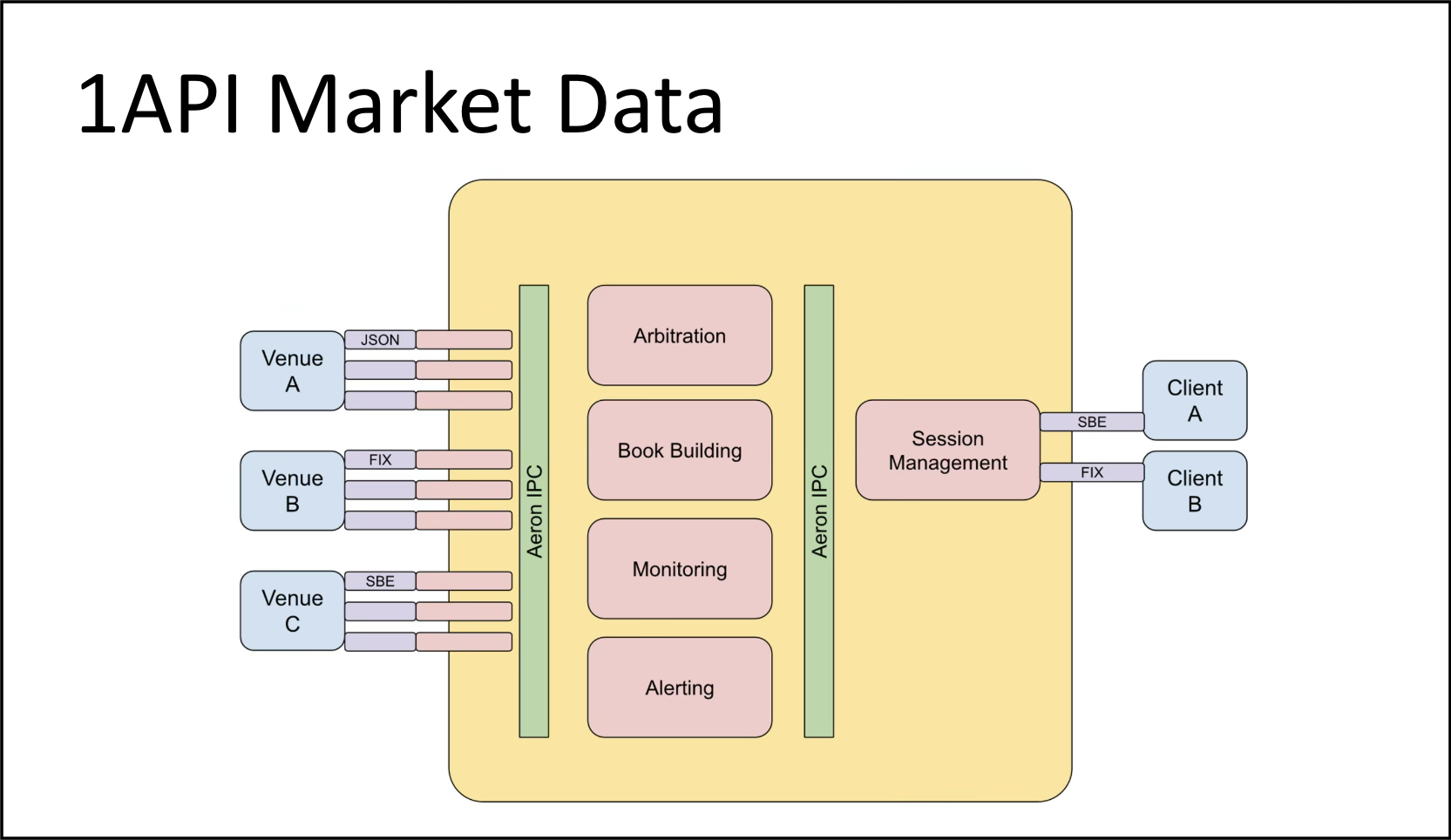
In its 1API Market Data and trading connectivity stack, 4OTC uses Aeron and SBE as the backbone of a modular monolith. Venue adapters ingest heterogeneous protocols, normalise data into a common SBE format, and publish events onto an Aeron IPC bus. Downstream components subscribe to those streams to perform functions such as redundancy management, book building, and alerting, and then feed client-facing session managers that deliver data over FIX or SBE. Non-latency-critical concerns such as web UIs and monitoring can be moved into separate processes and connected via IPC, keeping the latency-sensitive path lean.

4OTC connectivity architecture

4OTC’s connectivity architecture includes:

  • Venue adapters and protocol translators: Connect to multiple venues across asset classes using FIX, JSON/WebSocket, SBE over WebSocket, and other venue-specific formats, translating them into a unified internal SBE schema before publishing to the Aeron bus.
  • Modular monolith processing components: Small, deterministic “mini-services” consume SBE messages from Aeron Transport to perform tasks such as line arbitration across redundant sessions, multi-venue book building, and market data validation, then publish derived events back onto the bus.
  • Client session management and outbound protocols: Session managers subscribe to relevant streams on the bus and format outbound data to clients over FIX or SBE, with the ability to shard formatting and delivery so that slow consumers do not affect others.
  • IPC-connected sidecar services: Monitoring, analytics, and management tools attach to the same Aeron streams as sidecars, observing traffic and publishing metrics without interfering with the core processing pipeline.

The entire design allows 4OTC to keep latency-critical components co-located and tightly controlled, while still gaining many of the modularity and observability benefits often associated with microservices.

1API Market Data

1API Market Data architecture diagram showing venue feeds flowing through an Aeron/SBE-based modular monolith with arbitration, book building, monitoring, alerting, session management, and client delivery
4OTC 1API Market Data Architecture: Normalised venue feeds flow through an Aeron/SBE-based modular monolith, where redundancy, book building and validation are applied before ultra-low-latency delivery to client APIs.

For the full details, architecture diagrams and extended Q&A, watch the recording of Mark Price’s talk

Watch on demand

Get the full talk & Q&A

Fill in the form below and we’ll take you straight to Mark Price’s recording.


Technical elements and key learnings from 4OTC’s implementation

The technical implementation of 4OTC’s platform includes several critical elements that underpin its robustness and efficiency:

  • Modular monolith with SBE over Aeron Transport using IPC: Internal logic is organised into small, composable units that communicate only by using SBE over Aeron Transport, using IPC as an internal bus, which simplifies testing, debugging, and reasoning about system behaviour.
  • Lock-free, wait-free hot path: From packet ingress to outbound publish, the hottest paths are designed to avoid locks and blocking, and to be garbage-free in steady state, including hand-rolled parsing and carefully sized data structures.
  • Straightforward sharding via message boundaries: Because components are defined purely by their message interfaces, sharding workloads such as book building or FIX formatting across threads or cores is a configuration choice rather than a redesign.
  • IPC extensibility and replay-driven observability: Treating Aeron Transport as an application-level packet capture enables sidecar consumers for latency histograms, analytics, and replay-based debugging, giving engineers the ability to reproduce and analyse production issues from recorded streams.

The implementation benefits: rapid deployment and performance

By centering its design on Aeron and SBE, 4OTC is able to process billions of messages per day from hundreds of venues while meeting stringent latency requirements for institutional trading. The same architecture supports continuous delivery, with frequent production releases made possible by the clear message boundaries and deterministic behaviour of each component. The move from generic runtime queues to Agrona and then to Aeron Transport, using IPC has reduced jitter and improved predictability in the hot path, all while allowing the platform to grow in scope and scale.

Future plans for 4OTC’s connectivity platform

Looking ahead, 4OTC expects to continue expanding its use of Aeron-based patterns as message volumes, venue connectivity, and client demands increase. The focus is on further sharding and scaling of workloads within the modular monolith, adding more IPC-connected sidecar services for analytics and monitoring, and deepening replay-driven debugging and observability so that deterministic event streams remain central to both operations and development as the platform evolves.

  1. Mark Price 4OTC

    Mark Price Co-Founder
    4OTC

    LinkedIn LinkedIn profile

    Mark is Co-Founder of 4OTC, a London FinTech delivering ultra-low-latency FX and digital asset connectivity. A high-performance Java expert, he previously led performance engineering at LMAX Exchange.

Further reading

Website Learn more about Aeron Transport

Discover the world’s leading low-latency message transport system for performance, reliability and observability.

Case Study Man Group: Low-Latency FX Trading With Aeron Transport and Aeron Archive

How Man Group adopted Aeron Transport and Aeron Archive to cut latency in an automated FX system trading $1.5 trillion annually.

Tech Deep Dive Introducing SBE: Simple Binary Encoding

Zach Bray, Aeron Performance Engineer, gives a deep dive into SBE, the world’s most efficient message encoding standard.

Contact Talk to us

Have a question about Aeron, Aeron Premium or the Aeron Community? Get in touch.